- May 11, 2026
- Madre Janus
Cybersecurity today is no longer just about deploying a firewall and assuming the business is protected. Modern threats evolve continuously, and organizations that rely only on infrastructure deployment without ongoing management often leave critical security gaps exposed.
This is where a Fortinet MSSP becomes essential.
A Fortinet MSSP helps businesses move beyond basic deployment by providing continuous monitoring, threat detection, incident response, policy optimization, and long-term cybersecurity management.
As cyberattacks become more sophisticated across industries such as finance, oil & gas, healthcare, logistics, infrastructure, and enterprise IT, businesses are increasingly shifting from static security setups toward managed cybersecurity operations.
In this article, we explain:
- What a Fortinet MSSP is
- The difference between deployment and management
- Why deployment alone is no longer enough
- How managed Fortinet services improve security posture
- How businesses can strengthen operational resilience with enterprise cybersecurity strategies
What Is a Fortinet MSSP?
A Fortinet MSSP is a Managed Security Service Provider that continuously monitors, manages, and optimizes Fortinet cybersecurity infrastructure to improve threat detection, operational visibility, and long-term security resilience.
Unlike a standard deployment partner that installs infrastructure and exits after implementation, an MSSP actively manages cybersecurity operations on an ongoing basis.
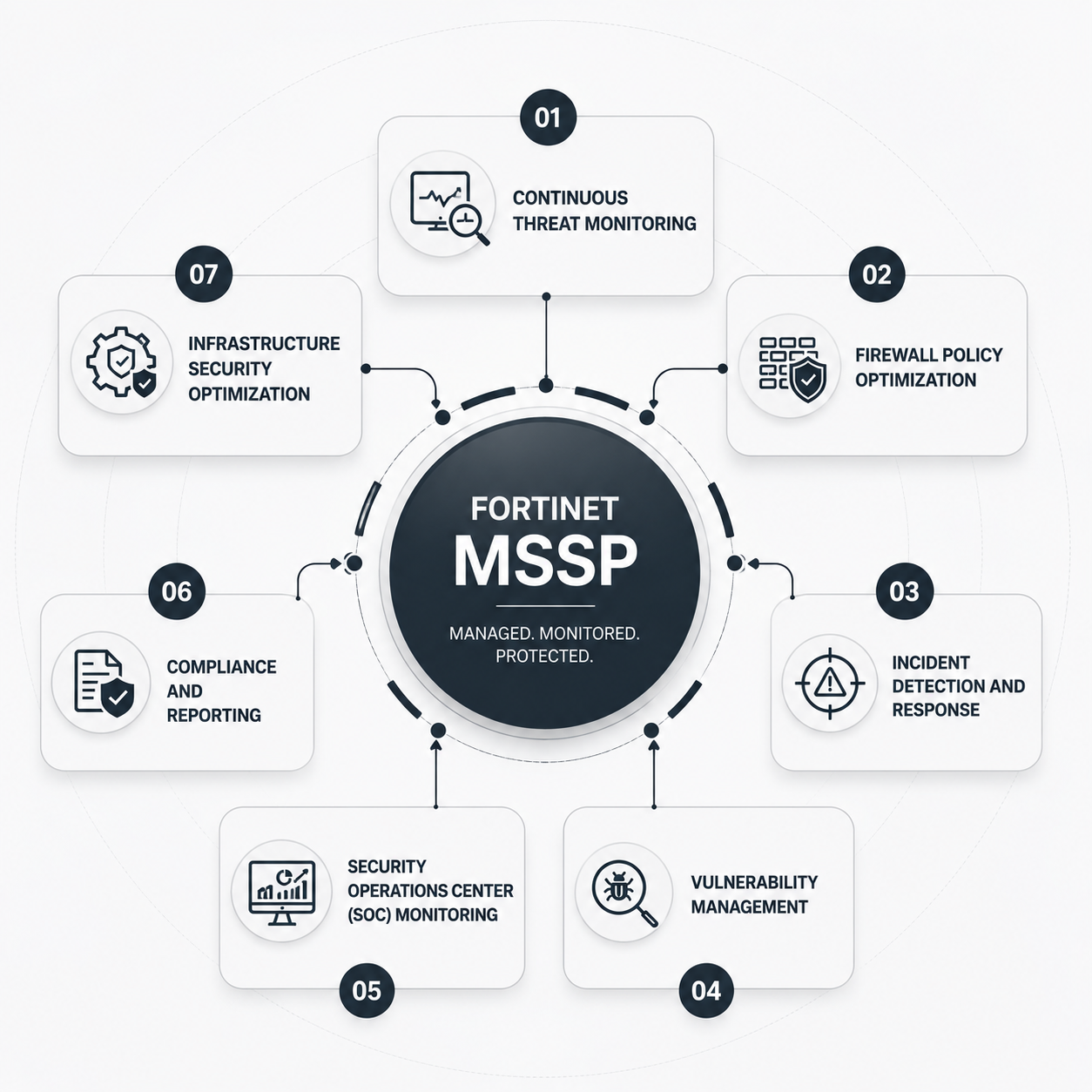
A Fortinet MSSP typically manages:
- FortiGate Firewalls
- Threat monitoring
- Intrusion prevention systems
- VPN security
- Security policy optimization
- Security event analysis
- Firmware and patch management
- SOC monitoring
- Incident response
- Compliance visibility
- Vulnerability management
This operational approach helps organizations maintain security continuously rather than relying on one-time deployment.
What Happens During a Standard Fortinet Deployment?
A traditional Fortinet deployment generally focuses on infrastructure setup and initial configuration.
This usually includes:
- Firewall installation
- VPN setup
- Network segmentation
- Security policy creation
- Initial configuration testing
- User access setup
- Basic implementation documentation
Once deployment is completed, ongoing management often becomes the responsibility of the internal IT team.
At this stage, businesses are expected to handle:
- Security monitoring
- Alert investigation
- Threat response
- Patch management
- Firewall optimization
- Security reporting
- Compliance checks
- Incident management
For many organizations, this becomes difficult to sustain consistently.
Why Deploying Fortinet Alone Is Not Enough
Many organizations assume cybersecurity infrastructure automatically equals cybersecurity protection.
In reality, unmanaged infrastructure can quickly become vulnerable due to:
- Outdated firewall rules
- Delayed firmware updates
- Alert fatigue
- Misconfigured access policies
- Unreviewed security logs
- Expanding attack surfaces
- Insider risks
- Evolving cyber threats
A deployed firewall is only as effective as the team actively monitoring and managing it.
Modern cyberattacks target operational weaknesses, not just perimeter defenses.
Without continuous oversight, businesses often operate reactively instead of proactively.
According to CISA Cybersecurity Guidance, continuous monitoring and proactive security management are critical components of modern cybersecurity resilience.
Fortinet Deployment vs Managed Fortinet Services
| Security Area | Deployment Only | Fortinet MSSP |
|---|---|---|
| Initial Configuration | Yes | Yes |
| 24/7 Threat Monitoring | No | Yes |
| Security Event Analysis | Limited | Continuous |
| Incident Response | Internal Responsibility | Managed Support |
| Firmware Updates | Manual | Proactively Managed |
| Firewall Optimization | Occasional | Continuous |
| Vulnerability Management | Limited | Ongoing |
| SOC Integration | Rarely Included | Included |
| Compliance Reporting | Minimal | Structured Visibility |
| Operational Security Management | Reactive | Proactive |
The core difference is operational continuity. Deployment focuses on implementation. Managed services focus on ongoing protection.
The Hidden Risks of “Set and Forget” Cybersecurity
One of the most common cybersecurity mistakes businesses make is treating deployment as the final step.
Cybersecurity is not static.
Threat landscapes change daily, and unmanaged environments often experience:
- Firewall rule drift
- Shadow IT expansion
- Weak access governance
- Unpatched vulnerabilities
- Increasing attack exposure
Over time, unmanaged systems can become less secure even if the original deployment was configured correctly.
This is especially risky for:
- Hybrid workforce environments
- Multi-site enterprises
- Cloud-connected infrastructure
- Industrial operations
- Oil & gas facilities
- Logistics networks
- Infrastructure projects
Organizations operating in business-critical environments require continuous visibility into their cybersecurity posture.
What Does a Fortinet MSSP Actually Manage?
Why Businesses Are Moving Toward Managed Security Models
Cybersecurity complexity has increased significantly over the last few years.
Organizations now face:
- Sophisticated ransomware attacks
- AI-driven phishing campaigns
- Expanding cloud infrastructure
- Remote workforce security risks
- Increasing compliance pressure
- Security talent shortages
Building and maintaining an internal 24/7 cybersecurity team is expensive and operationally challenging.
As a result, many enterprises are moving toward managed security partnerships that provide:
- Specialized expertise
- Faster incident response
- Continuous monitoring
- Reduced operational burden
- Improved security visibility
- Scalable cybersecurity operations
According to Gartner’s MSSP Overview, managed security services continue to play a critical role in helping organizations strengthen cybersecurity resilience while improving operational efficiency.
How Managed Fortinet Services Improve Security Posture
Organizations using managed Fortinet services benefit from:
- Faster threat detection
- Reduced incident response time
- Improved operational visibility
- Better compliance alignment
- Stronger firewall governance
- Lower long-term cybersecurity risk
- Enhanced infrastructure resilience
Instead of treating cybersecurity as a one-time deployment project, businesses gain continuous operational security management.
This shift is becoming increasingly important as attack surfaces expand across hybrid and cloud-connected environments.
How Madre Janus Supports Enterprise Cybersecurity
Madre Janus supports organizations with enterprise-focused cybersecurity solutions designed for modern infrastructure environments.
The focus extends beyond deployment toward operational cybersecurity resilience through:
- Managed cybersecurity services
- Security operations support
- Threat visibility
- Enterprise IT protection
- Infrastructure security management
- Operational continuity support
- Scalable cybersecurity operations
For businesses operating in high-risk sectors, cybersecurity requires continuous oversight, monitoring, and optimization rather than static implementation alone.
Organizations looking to improve operational cybersecurity visibility can also follow Madre Janus on LinkedIn for updates on cybersecurity trends, enterprise security strategies, and infrastructure protection insights.
Frequently Asked Questions
What is a Fortinet MSSP?
A Fortinet MSSP is a managed security service provider that continuously monitors, manages, and optimizes Fortinet cybersecurity infrastructure.
What is the difference between deployment and managed services?
Deployment focuses on installation and setup, while managed services provide ongoing monitoring, optimization, threat detection, and incident response.
Why do businesses need managed Fortinet security?
Businesses need managed Fortinet security to improve threat visibility, reduce cyber risk, strengthen operational resilience, and maintain continuous monitoring.
Does Fortinet require continuous monitoring?
Yes. Modern cyber threats evolve continuously, making ongoing monitoring critical for detecting suspicious activity and minimizing response time.
What are the benefits of managed firewall services?
Managed firewall services improve security visibility, optimize firewall performance, reduce operational burden, and strengthen incident response capabilities.